Vaccine for Ovarian Cancer
English
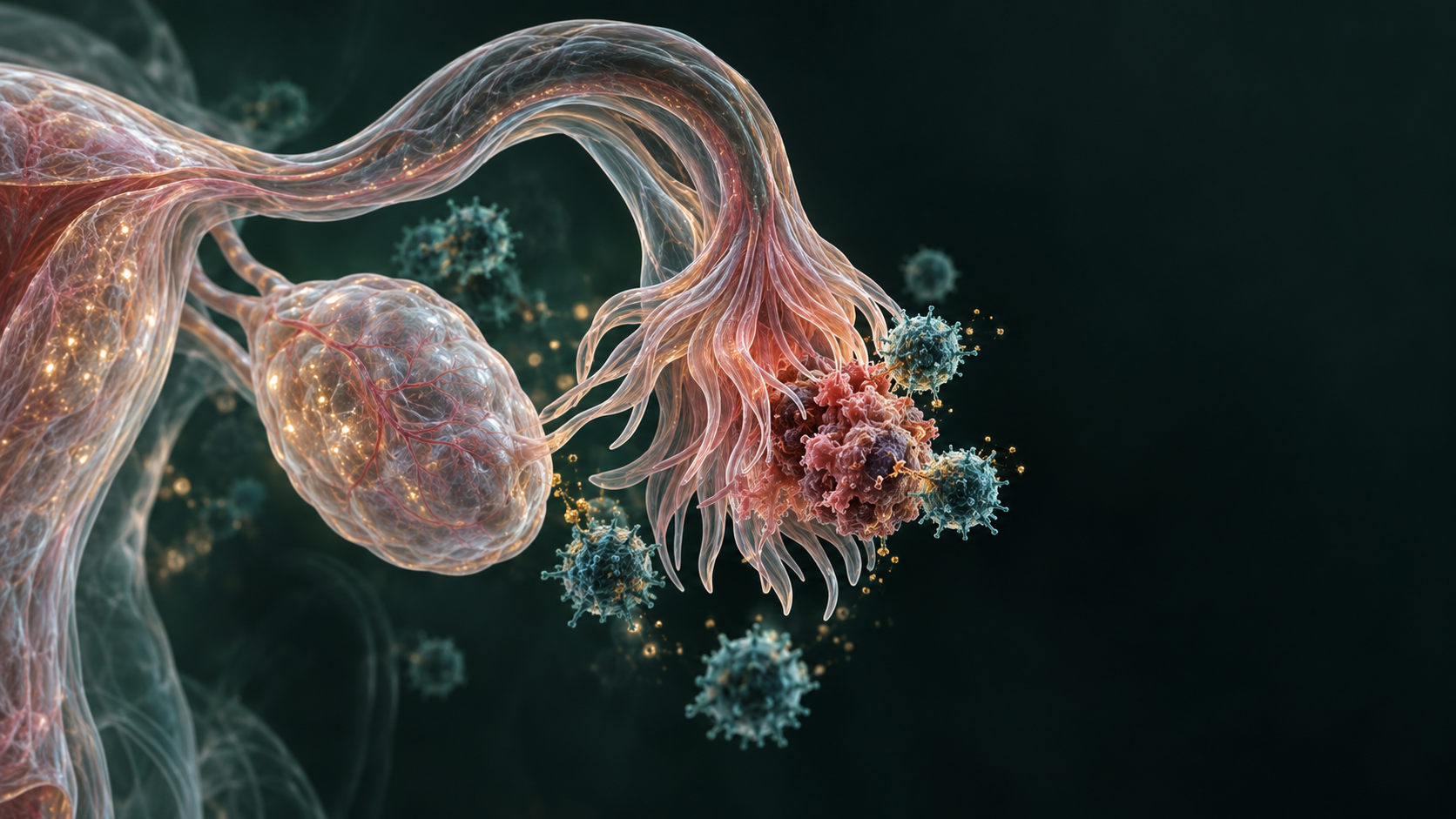
Scientific illustration of an ovary, fallopian tube, tumour cells and immune cells

Therapeutic vaccination remains investigational

Vaccine for
Ovarian Cancer

Can immunity delay recurrence, control microscopic residual disease, or prevent cancer in people with inherited risk?

Current positionNo ovarian cancer vaccine is approved. Several platforms have produced immune responses, but clinical benefit remains unproven.
Phase 2randomized folate-receptor vaccine evidence
120participants in the TPIV200 trial
No PFS gain10.9 versus 11.1 months
Many diseasesepithelial, germ-cell and stromal tumours differ

A clear evidence ledger

Immune activity is not the same as disease control

Ovarian cancer vaccine studies include peptides, dendritic cells, tumour-cell products, neoantigens, viral vectors and combinations. Most remain early-stage.

Randomized phase 2

Folate receptor-alpha peptide vaccine

TPIV200 plus GM-CSF was compared with GM-CSF alone after response to first-line platinum chemotherapy in 120 women with epithelial ovarian cancer.

The vaccine was well tolerated but did not improve progression-free survival: median 10.9 months versus 11.1 months. This is an important negative result, not a failed field; it shows that immunogenic targets and tolerability do not guarantee clinical benefit.

Evidence lessonFuture vaccines may need better target selection, combinations, timing, or biomarker-defined populations. Any claim of efficacy must survive a controlled comparison.

Three different ambitions

Prevention, treatment and recurrence are separate questions

None currently has an approved ovarian vaccine.

01

Prevent ovarian cancer

For BRCA1/2 and some other high-risk groups, risk-reducing surgery and specialist surveillance discussions remain the established approach. A vaccine that safely prevents tubal or ovarian carcinogenesis is a research goal, not current care.

02

Reduce recurrence

Minimal residual disease after surgery and chemotherapy is a logical vaccination window, but ovarian cancer is heterogeneous and can suppress immune activity. Controlled trials must show longer remission or survival.

03

Treat measurable disease

Vaccines may be combined with checkpoint inhibitors, antibodies, chemotherapy or cell therapy. Immunotherapy has not transformed unselected ovarian cancer in the way it has melanoma.

Immunotherapy guide

No guarantee: even an effective future vaccine would reduce risk, not make cancer impossible. Follow-up, symptom assessment and recommended care would remain necessary.

Ovarian cancer is an umbrella term

Histology changes biology, treatment and vaccine relevance

Many high-grade serous cancers probably begin in the fallopian-tube fimbria and are managed with ovarian and primary peritoneal cancers.

Most common family

Epithelial ovarian, fallopian-tube and primary peritoneal cancers

High-grade serous is the dominant subtype. Low-grade serous, endometrioid, clear-cell and mucinous cancers have different molecular features and treatment sensitivities. Vaccine findings in one subtype cannot automatically be generalized.

Germ cells

Ovarian germ-cell tumours

Dysgerminoma, yolk-sac tumour, embryonal carcinoma, immature teratoma and mixed forms arise from egg-forming cells and often affect younger people. Many are highly curable with specialist surgery and chemotherapy.

Supporting tissues

Sex cord-stromal tumours

Granulosa-cell, Sertoli-Leydig and related tumours arise from ovarian supporting and hormone-producing tissues. Hormonal presentation, natural history and treatment differ from epithelial cancer.

Rare entities

Small-cell and other uncommon tumours

Small-cell carcinoma of the ovary, hypercalcaemic type, and other rare pathologies require expert review and specialised multidisciplinary care.

The exact pathology report comes first. “Ovarian cancer” alone is not enough to judge prognosis, treatment, inherited risk or trial eligibility.

Symptoms and early detection

Persistent change deserves assessment

Possible symptoms include persistent bloating or abdominal enlargement, pelvic or abdominal pain, early fullness or appetite loss, urinary urgency or frequency, altered bowel function, fatigue, unexplained weight change and postmenopausal bleeding. These are common and usually have other causes; persistence, frequency and progression matter.

Postmenopausal bleeding should not be ignored

Even a small amount or a single episode needs assessment. It is not specific for ovarian cancer and more often prompts evaluation for uterine, cervical, vaginal or benign causes.

Precision treatment context

Vaccines sit beside surgery, systemic therapy and biomarkers

Standard care remains central while vaccine studies mature.

Surgery and chemotherapy

Specialist cytoreductive surgery and platinum-based chemotherapy underpin treatment for most advanced epithelial cancers.

Maintenance and targeted therapy

BRCA status, homologous-recombination biology, folate-receptor expression and prior platinum response may affect PARP-inhibitor, antibody-drug conjugate or other choices.

Immunotherapy

Checkpoint inhibitors and cell-based approaches are used selectively or in trials. Biomarkers and histology matter; benefit is not uniform.

Clinical trials

Search by exact tumour type

Include histology, stage, platinum sensitivity, biomarkers and previous treatment when discussing eligibility.

Connected guides

Evidence across prevention, treatment and detection

Research tools

Follow the evidence